
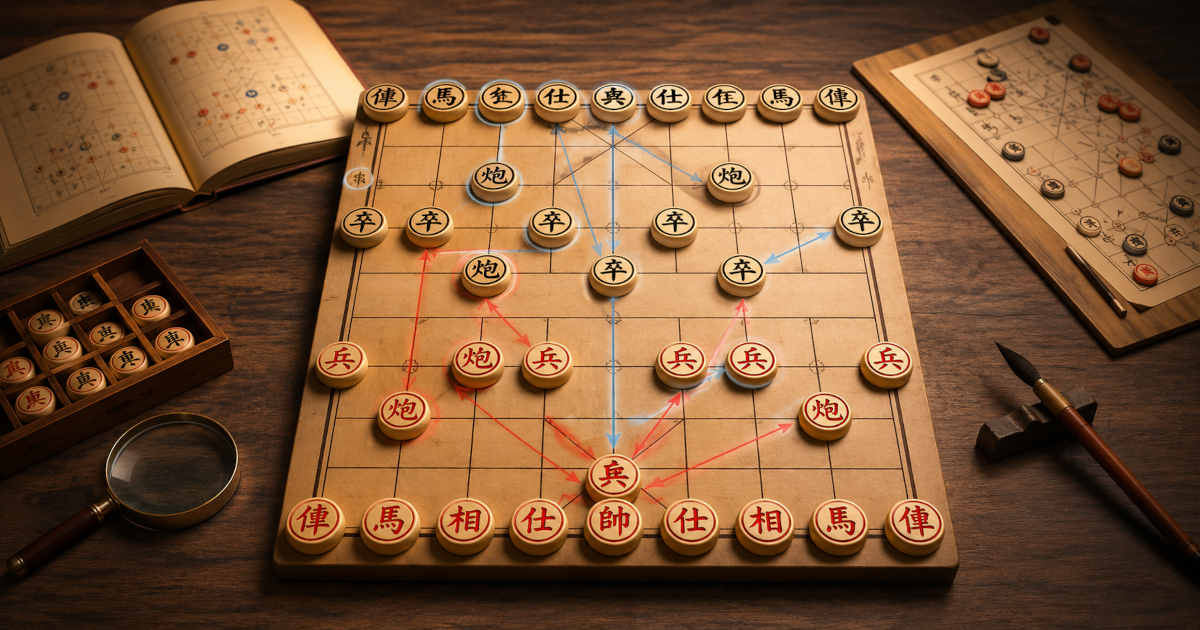
Xiangqi Terminology: A Complete Guide to Essential Chinese Chess Terms
Xiangqi, also known as Chinese Chess, is one of the most popular strategy board games in Vietnam and across many parts of Asia. To play Xiangqi well, knowing how the pieces move and understanding the basic rules are only the beginning. Players also need to understand common Xiangqi terminology used to describe openings, strategies, tactics, positions, middlegames, and endgames.
For beginners, encountering a large number of unfamiliar Xiangqi terms can make learning seem complicated. Terms such as Central Cannon, Screen Horse, Counter-Cannon Horse, check, sacrifice, exchange, and checkmate attack appear frequently in Xiangqi books, articles, commentaries, and tournament games.
This guide explains the most important Chinese Chess terms in a simple and practical way, helping both beginners and intermediate players build a stronger Xiangqi vocabulary.
What Is Xiangqi Terminology?
Xiangqi terminology refers to the words and phrases used to describe pieces, board positions, moves, tactics, strategies, openings, middlegames, and endgames in Chinese Chess.
For example, terms such as Central Cannon, Screen Horse, Counter-Cannon Horse, check, pin, sacrifice, exchange, initiative, and mating attack are all commonly used when discussing Xiangqi.
Understanding these terms can help players:
- Read Xiangqi books and articles more easily.
- Follow game commentary from strong players.
- Learn and remember common opening systems.
- Communicate more accurately with other Xiangqi players.
- Analyze games and improve their playing strength.
Basic Xiangqi Board Terminology
Xiangqi Board
A Xiangqi board consists of 9 vertical files and 10 horizontal ranks, creating intersections where the pieces are placed and moved. Unlike Western Chess, Xiangqi pieces are placed on the intersections rather than inside squares.
River
The middle of the Xiangqi board contains an empty area called the River. It divides the board into two sides, with each side belonging to one player.
The River is particularly important because certain pieces have restrictions related to crossing it.
Palace
The Palace, sometimes called the Fortress, is the special 3×3 area where the General and Advisors operate. The General must remain inside the Palace.
Controlling the Palace becomes especially important during tactical attacks and endgames.
Pawn Crossing the River
Before crossing the River, a Pawn can only move forward. After crossing the River, it gains the ability to move sideways as well.
This makes a Pawn significantly more valuable in many endgame positions.
Xiangqi Piece Terminology
General
The General is the most important piece in Xiangqi. The ultimate goal of the game is to checkmate the opponent's General.
The General has very limited mobility and must remain inside its Palace.
Advisor
The Advisor is a defensive piece whose main role is protecting the General. It moves diagonally one point and must remain inside the Palace.
Elephant
The Elephant moves diagonally exactly two points and cannot cross the River. It is mainly a defensive piece and plays an important role in protecting the General.
Chariot
The Chariot is one of the strongest pieces in Xiangqi. It moves horizontally or vertically for any number of unobstructed points.
Because of its mobility and attacking power, the Chariot is often extremely valuable in both middlegames and endgames.
Cannon
The Cannon is one of the most distinctive pieces in Xiangqi. It moves like a Chariot when it is not capturing.
However, when capturing, the Cannon must jump over exactly one piece, known as the screen or mounting piece, before reaching its target.
Horse
The Horse moves in an L-shaped pattern, similar to the Knight in Western Chess. However, unlike a Western Chess Knight, the Xiangqi Horse can be blocked by a piece occupying its adjacent Horse-leg point.
Therefore, players must pay close attention to blocked Horse routes.
Pawn
The Pawn moves forward one point before crossing the River. After crossing the River, it can also move sideways.
Although the Pawn is the weakest piece in terms of basic material value, advanced Pawns can become extremely dangerous in the endgame.
Xiangqi Opening Terminology
The opening is the first stage of a Xiangqi game. During this phase, players develop their pieces, establish formations, and compete for the initiative.
Central Cannon
The Central Cannon is one of the most famous and widely played Xiangqi opening systems.
In this opening, the Cannon is developed to the central file, creating immediate pressure against the opponent's central formation and General.
Central Cannon positions often lead to dynamic and tactical games with many possible variations.
Screen Horse
The Screen Horse is one of the most important defensive systems against the Central Cannon.
In a typical Screen Horse setup, the two Horses are developed to support the center and create a solid defensive formation.
Screen Horse is highly respected because it combines defensive stability with opportunities for counterattack.
Counter-Horse
The Counter-Horse, sometimes referred to as the Counter-Cannon Horse system depending on the variation, is another important opening formation.
The Horse arrangement creates a flexible defensive structure while preparing counterplay against the opponent's central forces.
Flying Elephant
The Flying Elephant opening involves developing the Elephants early in order to strengthen the defensive structure.
Depending on the exact variation, Flying Elephant positions may lead to relatively balanced and strategic games.
Initiative
The initiative refers to the ability to make moves that force the opponent to respond to your threats.
Having the initiative is often a major advantage because the player with the initiative can determine the direction of the game.
Xiangqi Tactical Terminology
Check
A check occurs when the opposing General is directly attacked.
The player in check must respond immediately by moving the General, capturing the attacking piece, blocking the attack where legal, or using another defensive resource.
Double Check
A double check occurs when the General is attacked simultaneously by two different lines or pieces.
This is a powerful tactical idea because defending against two threats at the same time can be extremely difficult.
Continuous Check
A continuous check is a sequence of consecutive checking moves that keeps the opposing General under constant pressure.
A successful series of checks can force the opponent into a losing position or lead directly to a mating attack.
Pin
A pin occurs when a piece cannot safely move because doing so would expose a more important piece behind it, especially the General.
Pins are important tactical tools and frequently appear in complicated Xiangqi middlegames.
Skewer
A skewer is a tactic in which a valuable piece is attacked and forced to move, exposing another valuable piece behind it.
The attacker can then capture the newly exposed target.
Trapping a Piece
Trapping a piece means restricting the opponent's mobility until a piece has very few useful moves or becomes effectively useless.
Trapped pieces may eventually be captured or forced into passive defensive positions.
Capture
A capture occurs when one of your pieces takes an opposing piece.
However, capturing material is not always automatically a good decision. Players must consider whether the opponent can recapture or gain a stronger tactical advantage afterward.
Exchange
An exchange means that both sides trade pieces, usually by capturing one another's units.
Exchanges can be beneficial when they simplify the position, eliminate dangerous attackers, or lead to a favorable endgame.
Sacrifice
A sacrifice means intentionally giving up a piece in order to gain a greater tactical or strategic advantage.
A successful sacrifice might result in a check, winning a Chariot, destroying the opponent's defensive formation, or creating a mating attack.
Cannon Screen
A Cannon screen is the piece positioned between a Cannon and its intended capture target.
The Cannon must jump over this screen to capture.
Cannon Mount
A Cannon mount is another term commonly used to describe the piece that serves as the Cannon's jumping platform.
The position of the Cannon mount can completely change the tactical possibilities of a position.
Middlegame Terminology
Middlegame
The middlegame begins after the opening, when most of the pieces have been developed and both players begin carrying out more complex strategic and tactical plans.
This stage often requires accurate calculation, piece coordination, and long-term planning.
Attack
An attack means actively putting pressure on the opponent's position, General, or important pieces.
Strong attacks usually depend on good piece coordination rather than a single piece acting alone.
Defense
Defense means protecting your position, reinforcing vulnerable pieces, and preventing the opponent from launching dangerous threats.
Good defensive play is not simply passive. Strong players often defend while preparing a counterattack.
Balanced Attack and Defense
A player who combines attack and defense effectively can maintain pressure without exposing their own General or pieces.
This balance is an important part of strong Xiangqi play.
Advantage
A player is said to have an advantage when their position, material, activity, or strategic prospects are better than those of the opponent.
An advantage can come from extra material, better piece activity, stronger central control, or a more dangerous attack.
Xiangqi Endgame Terminology
Endgame
The endgame is the final stage of a Xiangqi game, when many pieces have already been exchanged or captured.
Endgames require different skills from openings. Players must understand material values, General activity, Pawn advancement, and precise tactical techniques.
Chariot Endgame
A Chariot endgame is an endgame where one or more Chariots remain on the board along with supporting pieces.
Chariot endgames are common and often require very accurate calculation.
Cannon Endgame
A Cannon endgame focuses on using the Cannon effectively together with the General, Advisors, Elephants, or Pawns.
Because the Cannon requires a screen to capture, tactical details are especially important.
Passed Pawn
A passed Pawn is a Pawn that has advanced into a position where it has strong potential to move toward promotion-like winning conditions because there are few opposing Pawns capable of stopping it.
In Xiangqi, advanced Pawns can become powerful attacking resources despite their low initial value.
Mating Attack
A mating attack is a sequence of moves designed to force the opponent's General into a position where checkmate becomes unavoidable.
Mating attacks are often the final objective of a successful offensive.
Important Xiangqi Strategic Terms
Position
A position refers to the overall arrangement of both players' pieces on the board.
A strong position is not necessarily one in which a player has more material. Good coordination, safety, mobility, and control of important areas may be even more important.
Space
Space refers to the amount of room available for pieces to operate.
Greater space can give a player more options while restricting the opponent's pieces.
Piece Coordination
Piece coordination means using multiple pieces together to achieve a common objective.
For example, a Chariot, Cannon, and Horse attacking the same side of the board can create much greater pressure than the same pieces operating independently.
Initiative
Maintaining the initiative means continually creating threats that require the opponent to respond.
Sometimes a player can even be down material while still having a favorable position because they maintain strong initiative and attacking chances.
Why Should You Learn Xiangqi Terminology?
Learning Xiangqi terminology is about much more than memorizing vocabulary. It helps players develop a better understanding of the ideas behind the game.
Once a player understands the concept of a sacrifice, for example, they can recognize that losing a piece is not necessarily a mistake. When they understand the initiative, they begin to evaluate moves based on pressure and activity rather than simply material gain. When they understand a mating attack, they can search for combinations that lead to checkmate instead of focusing only on capturing pieces.
Terminology also makes it much easier to study famous games, opening theory, tactical puzzles, and expert commentary.
How to Learn Xiangqi Terms Effectively
Instead of trying to memorize every term at once, beginners should divide Xiangqi vocabulary into several groups: pieces, board terminology, openings, tactics, middlegame concepts, and endgame concepts.
Then, apply each term to actual games.
For example, when playing a Central Cannon opening against a Screen Horse defense, try to identify which move develops a piece, which move gains the initiative, and which exchange changes the structure of the position.
Learning through practical games is generally much more effective than memorizing definitions alone.
Conclusion
Understanding Xiangqi terminology is an essential step for anyone who wants to learn and improve at Chinese Chess. From basic terms such as General, Chariot, Cannon, and Horse to advanced concepts such as Central Cannon, Screen Horse, Counter-Horse, sacrifice, double check, initiative, and mating attack, each term represents an important part of Xiangqi strategy and tactical thinking.
Once you understand this vocabulary, it becomes much easier to read Xiangqi books, follow expert game analysis, study opening systems, and understand professional commentary.
For beginners, the best approach is to start with basic terms and gradually move into openings, tactics, middlegame strategy, and endgame techniques. With regular practice, these terms will become more than words—you will begin to recognize them directly on the board.
And that is the real turning point in Xiangqi: when you stop seeing the board as a collection of pieces and start seeing patterns, threats, ideas, and plans.
