
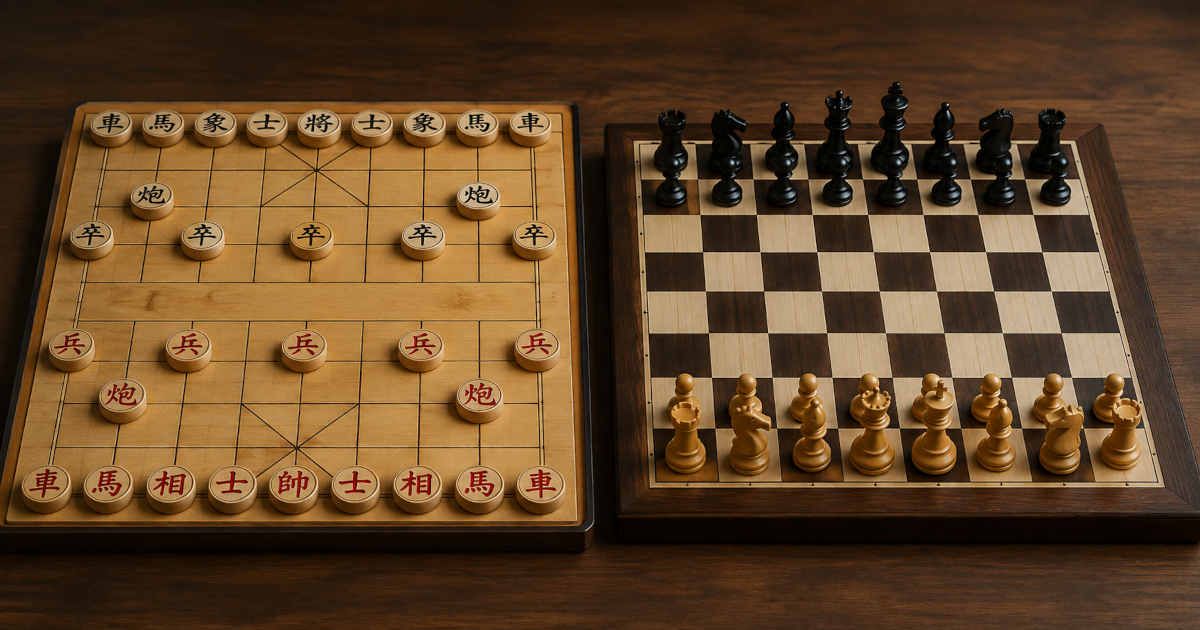
Xiangqi vs. Chess: Comparing the Rules, Board, Pieces, and Strategies
What Are the Differences Between Xiangqi and Chess?
Xiangqi and Chess are two of the world's most famous strategy board games. Both require logical thinking, calculation, strategic planning, and the ability to anticipate an opponent's moves. Although they share the basic objective of checkmating the opponent's key piece, they differ significantly in terms of board design, pieces, movement rules, strategies, and overall playing experience.
Xiangqi, also known as Chinese Chess, has a long history in China and has become particularly popular in Vietnam and other Asian countries. Chess, meanwhile, has developed into one of the world's most widely played strategy games, with an extensive international tournament system.
So, how is Xiangqi different from Chess? Let's take a closer look.
1. Differences in the Chessboard
One of the most noticeable differences between Xiangqi and Chess is the design of the board.
A Xiangqi board has 9 vertical lines and 10 horizontal lines, creating 90 intersections. Unlike Chess, Xiangqi pieces are placed on the intersections of the lines, rather than inside squares.
The Xiangqi board also contains a special area called the Palace, where the General and Advisors operate. In the middle of the board is a horizontal gap known as the river, which divides the board into two territories. The river plays an important role because some pieces, particularly the Soldiers, gain additional movement abilities after crossing it.
In contrast, a Chessboard consists of 8 ranks and 8 files, creating 64 alternating-colored squares. Chess pieces are placed inside these squares rather than on intersections.
Therefore, the board itself already creates very different ways of thinking and planning in the two games.
2. Comparing the Number and Types of Pieces
Each player in Xiangqi has 16 pieces, consisting of:
- 1 General
- 2 Advisors
- 2 Elephants
- 2 Horses
- 2 Chariots
- 2 Cannons
- 5 Soldiers
Chess also gives each player 16 pieces, but the composition is different:
- 1 King
- 1 Queen
- 2 Rooks
- 2 Bishops
- 2 Knights
- 8 Pawns
One of the most distinctive features of Xiangqi is the Cannon, a piece that does not exist in Chess. A Cannon moves like a Chariot when it is not capturing. When capturing, however, it must jump over exactly one piece, known as a screen. This creates many unique tactical possibilities.
Chess, on the other hand, has the Queen, generally considered the most powerful piece on the board because it can move horizontally, vertically, and diagonally across multiple squares.
3. Differences in Piece Movement
General and King
In Xiangqi, the General can move only within the Palace. It moves one point horizontally or vertically at a time. The two Generals are also not allowed to face each other directly along the same open file.
In Chess, the King can move one square in any direction, including horizontally, vertically, and diagonally. It is not restricted to a specific area of the board.
This creates important differences in defensive strategy.
Advisors and Bishops
The Advisor in Xiangqi moves one point diagonally and must remain inside the Palace. As a result, its mobility is relatively limited.
The Elephant in Xiangqi moves exactly two points diagonally and cannot cross the river. If another piece occupies the midpoint of its path, the Elephant cannot move in that direction. This is commonly referred to as a blocked Elephant's eye.
In Chess, the Bishop can move diagonally across any number of squares as long as its path is not blocked.
Horses and Knights
The Horse in Xiangqi and the Knight in Chess have broadly similar movement patterns, both using an L-shaped movement.
However, Xiangqi has a special rule known as the blocked Horse's leg.
If another piece occupies a point immediately adjacent to the Horse in the direction of movement, the Horse cannot move in that direction.
Chess does not have this restriction, which gives the Knight greater freedom in certain positions.
Chariots and Rooks
The Chariot in Xiangqi and the Rook in Chess are among the most similar pieces in the two games. Both can move horizontally or vertically over any number of unobstructed spaces.
However, because the boards and piece formations are different, their strategic roles are not exactly the same.
Cannon and Queen
The Cannon and Queen represent one of the biggest differences between Xiangqi and Chess.
In Xiangqi, the Cannon moves like a Chariot when making a non-capturing move. To capture an enemy piece, however, it must jump over exactly one intervening piece.
In Chess, the Queen can move horizontally, vertically, or diagonally across multiple squares. Its enormous range allows it to play a major role in both attack and defense.
4. Differences Between Soldiers and Pawns
Xiangqi has 5 Soldiers per player, while Chess has 8 Pawns.
At the beginning of a Xiangqi game, a Soldier can move one point forward. After crossing the river, it gains the additional ability to move horizontally.
This makes advancing Soldiers across the river an important strategic consideration, especially in the middlegame and endgame.
In Chess, a Pawn can move one square forward, or two squares from its starting position. It captures diagonally rather than moving straight forward to capture.
Another unique feature of Chess is pawn promotion. When a Pawn reaches the opponent's back rank, it can usually be promoted to a Queen, or to another major piece.
Xiangqi does not have a corresponding promotion rule.
5. Differences in Check and Checkmate Rules
In Xiangqi, the objective is to checkmate the opponent's General or put the opponent in a position where they have no legal moves.
The General must never be left in check.
In Chess, the objective is to checkmate the opponent's King, meaning the King is under attack and has no legal way to escape.
A particularly important Xiangqi rule is that the two Generals cannot directly face each other along the same file without another piece between them. This creates tactical situations that are unique to Chinese Chess.
6. Is Xiangqi or Chess More Difficult?
The question of whether Xiangqi or Chess is harder does not have a definitive answer.
Xiangqi offers an enormous number of tactical possibilities because of the Cannon, river, Palace, and numerous special movement rules. Its wider board also provides more open space for pieces to maneuver.
Chess has an equally deep strategic and theoretical structure. Concepts such as castling, en passant, pawn promotion, center control, pawn structures, and long-term positional planning create tremendous complexity.
For beginners, Xiangqi may initially seem more complicated because several pieces have special movement rules. Chess may appear easier to learn at the basic level, but its complexity increases dramatically as players move into advanced strategy and opening theory.
In other words, both Xiangqi and Chess are difficult, but they are difficult in different ways.
7. Differences in Opening Strategy
Xiangqi openings often focus on developing the Chariots, Horses, and Cannons while establishing a strong defensive structure. Famous opening systems include Screen Horse Defense, Central Cannon, Palace Horse, Cannon against Cannon, and various other established formations.
Many of these openings have been studied through thousands of games and extensive theoretical analysis.
Chess also has a huge collection of famous opening systems, including the Italian Game, Sicilian Defense, French Defense, Queen's Gambit, and King's Indian Defense.
The underlying principle is similar in both games: players want to develop their pieces efficiently, control strategically important areas, protect their King or General, and prepare for the middlegame.
8. Differences in Tactics
Xiangqi is famous for tactical ideas such as:
- Continuous checks
- Cannon pins
- Double Cannon attacks
- Chariot invasions
- Sacrificial attacks
- Direct mating attacks
Chess, meanwhile, has tactical motifs such as:
- Forks
- Pins
- Skewers
- Discovered attacks
- Double attacks
- Zugzwang
- Sacrifices
Many tactical concepts are similar in principle between the two games. However, their execution is very different because the boards, pieces, and rules are fundamentally different.
9. Xiangqi Often Emphasizes Direct Attacks
An interesting characteristic of Xiangqi is the highly direct nature of attacks against the General.
Chariots, Cannons, and Horses can quickly coordinate to create powerful attacking formations. Since the General is confined to a relatively small Palace, protecting the General and controlling the surrounding squares are extremely important.
A single inaccurate move can sometimes allow an opponent to launch a dangerous attack surprisingly quickly.
This gives many Xiangqi games an intense tactical character.
10. Chess Emphasizes Control of the Center
In Chess, controlling the center is one of the fundamental strategic principles.
Central squares give pieces more mobility and create opportunities for further development. Pawns, Knights, Bishops, and the Queen often work together to establish or challenge control of the center.
Xiangqi also involves central control, but the river, Palace, and open intersection-based board create a very different strategic environment.
Instead of focusing only on occupying central squares, Xiangqi players frequently have to consider lines of attack, piece coordination, river crossings, and access to the opponent's Palace.
11. Xiangqi and Chess in Modern Competition
Both Xiangqi and Chess have large communities of players and established competitive systems.
Chess has an enormous global tournament infrastructure, with internationally recognized titles such as International Master (IM) and Grandmaster (GM).
Xiangqi also has professional competition and international tournaments, particularly in China, Vietnam, and communities around the world where Chinese Chess is popular.
Today, both games are strongly supported by computers and artificial intelligence. Chess engines and Xiangqi engines can analyze enormous numbers of positions, helping players study openings, middlegames, endgames, tactical combinations, and strategic ideas.
Modern AI has also made it much easier for players to analyze their own games and identify mistakes that might otherwise go unnoticed.
12. Should You Learn Xiangqi or Chess?
The choice ultimately depends on your personal interests.
If you enjoy highly tactical games, powerful Cannon attacks, direct attacks on the General, and the distinctive strategic culture surrounding Chinese Chess, Xiangqi can be an excellent choice.
If you prefer a game with a huge international community, an enormous amount of English-language learning material, and a deeply developed global tournament ecosystem, Chess may be more suitable.
There is also no reason to choose only one.
Learning both games can help develop logical thinking, calculation skills, pattern recognition, strategic planning, and the ability to anticipate an opponent's ideas.
Xiangqi vs. Chess: Comparison Table
| Feature | Xiangqi | Chess |
|---|---|---|
| International name | Xiangqi | Chess |
| Board | 9 × 10 lines/intersections | 8 × 8 squares |
| Pieces per player | 16 | 16 |
| Royal piece | General | King |
| Signature piece | Cannon | Queen |
| River | Yes | No |
| Palace | Yes | No |
| Soldiers/Pawns | 5 | 8 |
| Promotion | No | Yes |
| Castling | No | Yes |
| Horse/knight obstruction | Yes | No |
| Elephant/Bishop movement | Cannot cross the river | Long-range diagonal movement |
| Attack style | Often highly direct | Tactical and positional |
| Global popularity | Particularly strong in Asia | Global |
Conclusion
Xiangqi and Chess are both remarkably deep strategy games. Although each player has 16 pieces and both games ultimately revolve around checkmating the opponent's most important piece, they provide very different experiences.
Xiangqi stands out because of its Cannons, river, Palace, the flying General rule, and highly tactical attacking patterns. Chess stands out because of its Queen, castling, pawn promotion, center control, and enormous body of strategic and opening theory.
There is no need to declare one game objectively "better." Xiangqi has its own unique beauty, while Chess has its own.
One can force you to calculate a deadly Cannon combination several moves ahead. The other can leave you staring at a position for 30 minutes before realizing that you blundered your Queen 12 moves ago. 😄
The most interesting thing is that once you play both games seriously, you may find that many skills can transfer between them. Tactical calculation, positional awareness, planning, pattern recognition, and the ability to anticipate an opponent's ideas can all improve through practice.
Whether you choose Xiangqi or Chess, the most important thing is to keep playing, analyze your games, learn from your mistakes, and continuously explore new positions and strategies.
