
Bình Phong Mã (Screen Horse): A Complete Guide to One of Xiangqi’s Most Popular Openings
Bình Phong Mã, known in English as the Screen Horse, is one of the most important and popular opening systems in Xiangqi (Chinese Chess). It is especially well known for its solid defensive structure, strong control of the center, and ability to transition smoothly from defense to counterattack.
For many Xiangqi players, learning the Screen Horse is an essential step toward becoming a stronger positional player. Unlike openings that rely heavily on immediate tactical attacks, the Screen Horse focuses on developing the Knights, protecting key central points, coordinating the major pieces, and preparing a flexible response to the opponent's plans.
In this guide, we will explore what the Screen Horse is, how the formation works, why it is effective, its strengths and weaknesses, common strategic ideas, and how beginners can learn to play Bình Phong Mã more effectively.
What Is Bình Phong Mã (Screen Horse)?
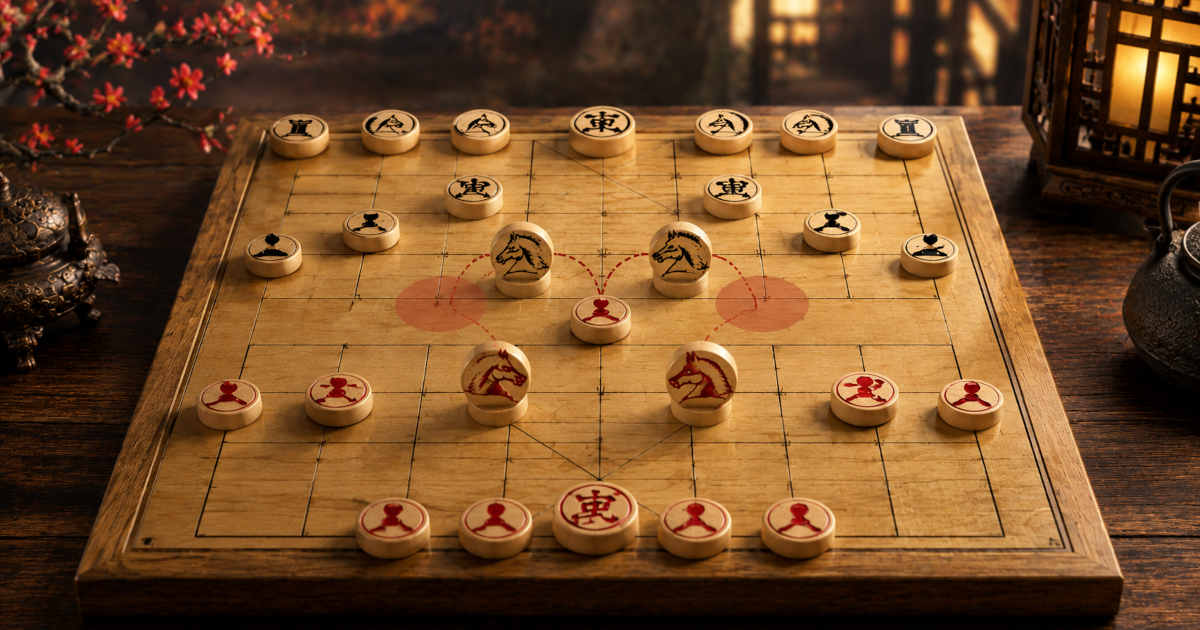
Bình Phong Mã, or Screen Horse, is a Xiangqi opening system in which the two Knights are developed early to create a strong defensive formation around the center.
The name Screen Horse refers to the role of the Knights as a defensive screen. Rather than allowing the opponent to attack the central area directly, the Horses are developed to help protect important pieces and squares while preparing the rest of the army for active play.
The Screen Horse is most famously associated with positions against the Central Cannon, one of the most aggressive opening systems in Xiangqi.
When facing a Central Cannon, the second player often needs to deal with immediate pressure against the central file and key defensive points. The Screen Horse provides a reliable way to meet this pressure while keeping enough flexibility to launch a counterattack later.
This is what makes the opening so powerful: it is defensive without being purely passive.
Why Is the Screen Horse So Popular?
The Screen Horse has remained one of the fundamental Xiangqi openings because it combines solid defense, flexible development, and counterattacking potential.
A well-played Screen Horse position offers several important advantages.
First, the Horses help strengthen the central area and reduce the effectiveness of direct attacks.
Second, the formation allows the Chariots, Cannons, and other pieces to develop naturally behind the defensive structure.
Third, the player can choose from many different plans depending on the opponent's setup.
This flexibility is especially useful in practical games. You do not need to follow one fixed plan for the entire game. Instead, you can develop your pieces, observe the opponent's weaknesses, and decide whether to defend, exchange pieces, or counterattack.
For this reason, the Screen Horse is suitable for both beginners learning Xiangqi strategy and experienced players who want a reliable opening repertoire.
The Basic Idea Behind the Screen Horse
The most important thing to understand is that Screen Horse is not simply a sequence of Knight moves.
The true strength of the opening comes from piece coordination.
The Horses form the first layer of defense, but they must work together with the Cannons, Chariots, Advisors, Elephants, and Pawns.
The general strategic goals are:
- Develop the Horses to support the center.
- Protect important central points.
- Develop the Chariots and Cannons efficiently.
- Keep the General safe.
- Prevent the opponent from gaining an easy initiative.
- Look for opportunities to counterattack.
A common mistake is to think that Screen Horse means “defend first and attack later.” A stronger way to think about it is:
Defend actively, improve your position, and counterattack when the opponent overextends.
That mindset is essential for playing the opening successfully.
Screen Horse vs. Central Cannon
The classic battle between Screen Horse and Central Cannon is one of the most important opening structures in Xiangqi.
The Central Cannon player usually wants to take control of the center and create immediate threats. The Screen Horse player responds by developing the Knights and establishing a defensive network capable of resisting the attack.
The strategic battle is not necessarily about winning material immediately. Instead, both sides are fighting for:
- Central control
- Piece activity
- Development speed
- King safety
- Space
- Initiative
The Central Cannon generally aims for active pressure, while the Screen Horse seeks to absorb that pressure and create opportunities for a well-timed counterattack.
This makes the matchup particularly educational for beginners because it demonstrates the difference between initiative and defensive coordination.
How to Develop a Screen Horse Position
The exact move order can vary depending on the opponent's choices, but the strategic process can be understood in several stages.
1. Establish Central Stability
The first goal is to prevent the opponent from gaining a completely dominant position in the center.
Central stability provides the foundation for the entire Screen Horse formation.
2. Develop the Horses
The two Horses are the defining pieces of the opening.
Their positions should help protect the center while also providing mobility for future attacks.
The Horses should not be developed simply because “that is how Screen Horse is played.” Their placement must support the overall position.
3. Bring the Chariots Into Play
After developing the Horses, activating the Chariots becomes a major priority.
Chariots are among the most powerful pieces in Xiangqi, but they can become ineffective if their paths remain blocked.
A strong Screen Horse player therefore looks for opportunities to open files and bring the Chariots into active positions.
4. Coordinate the Cannons
Cannons are extremely important in Screen Horse positions because they can support defensive points, attack enemy pieces, and cooperate with Chariots and Horses.
Good Cannon placement often determines whether a Screen Horse position remains passive or becomes an active counterattacking system.
5. Prepare the Counterattack
Once your pieces are developed and your position is stable, you should stop thinking only about defense.
Look for weaknesses in the opponent's position.
Ask:
- Which wing is weak?
- Which piece is poorly defended?
- Which file can be opened?
- Has the opponent moved too many pieces forward?
- Can a Pawn advance create a new attack?
This is where the Screen Horse begins to show its true strategic strength.
Advantages of the Screen Horse
Strong Central Defense
The greatest strength of the Screen Horse is its ability to resist direct pressure in the center.
The Horse formation makes it difficult for the opponent to attack the central area with only a few pieces. The defending pieces can support each other and create multiple layers of protection.
Excellent Flexibility
Screen Horse is not tied to one single attacking plan.
Depending on the position, the player can attack on the left wing, right wing, or center. This makes the opening highly adaptable.
Strong Counterattacking Potential
A well-built defensive formation gives the player a stable platform from which to launch a counterattack.
This is especially dangerous when the opponent has pushed too many pieces forward or weakened one side of the board.
Good Long-Term Structure
The Screen Horse is particularly useful for players who enjoy strategic games.
Instead of relying entirely on tactical tricks, the player can gradually improve piece placement and create pressure over time.
Disadvantages of the Screen Horse
Although Screen Horse is highly respected, it is not automatically a winning system.
It Can Become Too Passive
The biggest danger is passive play.
If you keep defending without creating counterplay, your opponent may gradually take control of the game.
A Screen Horse player must know when it is time to stop defending and start fighting for the initiative.
It Requires Good Middlegame Understanding
The opening itself does not determine the result of the game.
After the initial development, many Screen Horse positions become strategically complex. Players need to understand exchanges, Pawn structures, piece activity, and attacking plans.
Timing Is Critical
Moving a Horse, Cannon, or Pawn at the wrong moment can weaken the entire formation.
The Screen Horse rewards players who understand when to make a move, not just what move to make.
Important Screen Horse Strategies
Counterattack on the Wings
When the opponent concentrates heavily on the center, attacking a wing can be an effective way to create counterplay.
A wing attack can force the opponent to move defensive pieces away from the center.
Exchange the Right Pieces
Piece exchanges can be extremely useful when facing strong central pressure.
However, not every exchange is beneficial.
Before trading, consider:
- Which piece is stronger?
- Which piece is more active?
- Who benefits from simplification?
- Will the resulting endgame favor you?
Good Screen Horse players are often very selective about exchanges.
Keep the Horses Active
The Horses are not merely defensive pieces.
As the game develops, they can attack enemy Pawns, control key squares, support tactical operations, and participate in mating attacks.
If your Horses become trapped or inactive, much of the strategic value of the Screen Horse disappears.
Coordinate the Major Pieces
The Chariots, Cannons, and Horses should work as a team.
A Chariot attacking alone can often be stopped. A Cannon attacking alone may have limited effect. But when multiple pieces coordinate against the same target, tactical opportunities can appear very quickly.
Common Mistakes Beginners Make
Learning Screen Horse is easier when you know which mistakes to avoid.
Memorizing Moves Without Understanding Them
Many beginners try to memorize opening variations without understanding the purpose behind them.
This often causes problems when the opponent makes an unexpected move.
Instead of memorizing everything, learn the underlying principles first.
Developing Pieces Too Slowly
A defensive opening does not mean that development can be slow.
Your Chariots and Cannons still need to become active. Otherwise, your opponent can gain too much space and initiative.
Defending Every Threat
Not every threat needs to be answered defensively.
Sometimes the strongest response is to create an even stronger threat elsewhere.
This is one of the most important ideas to learn when progressing from beginner to intermediate level.
Ignoring the Wings
A player who focuses entirely on the center may overlook attacks developing on either side of the board.
Screen Horse positions often require players to switch their attention rapidly from the center to a wing.
Is Screen Horse Good for Beginners?
Yes. The Screen Horse is one of the best opening systems for beginners who want to learn fundamental Xiangqi concepts.
It teaches several important principles:
- Develop your pieces efficiently.
- Protect the center.
- Coordinate multiple pieces.
- Keep your General safe.
- Recognize your opponent's threats.
- Look for counterattacking opportunities.
- Understand when exchanges are favorable.
However, beginners should avoid trying to memorize long theoretical variations immediately.
A better approach is to understand the ideas behind the moves.
Once you understand why the Horses are developed, why the center needs protection, and how the Chariots and Cannons should become active, you will be much better prepared for unfamiliar positions.
How to Practice the Screen Horse
Theory is useful, but practical experience is essential.
One of the best ways to learn Screen Horse is to play many games using the opening and review them afterward.
After each game, ask yourself:
- Did I develop my pieces efficiently?
- Did I allow the opponent too much central control?
- Was my defense too passive?
- Did I miss a counterattack?
- Did I exchange the right pieces?
- Which move caused my position to become difficult?
You can also practice by studying tactical puzzles and replaying famous Screen Horse games.
Another useful method is to play against different opening setups. This helps you learn how to adapt instead of relying on one fixed sequence of moves.
Screen Horse and Modern Xiangqi
Screen Horse remains a fundamental concept in modern Xiangqi theory and practical play.
Although computer engines and modern analysis have introduced many new ideas, the basic strategic concepts behind the opening remain highly relevant: strong piece coordination, central control, flexible development, and timely counterattack.
Studying Screen Horse can therefore help players understand not only one specific opening but also broader Xiangqi principles.
The deeper lesson is that a strong defensive formation should create active possibilities, not simply reduce risk.
Final Thoughts
Bình Phong Mã, or Screen Horse, is one of the most important defensive opening systems in Xiangqi. Its popularity comes from its combination of strong central defense, flexible piece development, and powerful counterattacking possibilities.
For beginners, the Screen Horse provides an excellent introduction to positional Xiangqi. It teaches players how to coordinate pieces, protect the center, develop efficiently, and recognize the right moment to change from defense to attack.
For more experienced players, Screen Horse offers a huge number of strategic and tactical possibilities. Its many variations can lead to rich middlegame positions where accurate calculation, piece coordination, and positional judgment become critical.
The key is not to treat Screen Horse as a fixed collection of opening moves. Instead, think of it as a strategic framework.
Build your defensive structure. Develop your pieces. Watch your opponent's weaknesses. Then, when the opportunity appears, strike.
That is the real power of Bình Phong Mã — the Screen Horse.
