
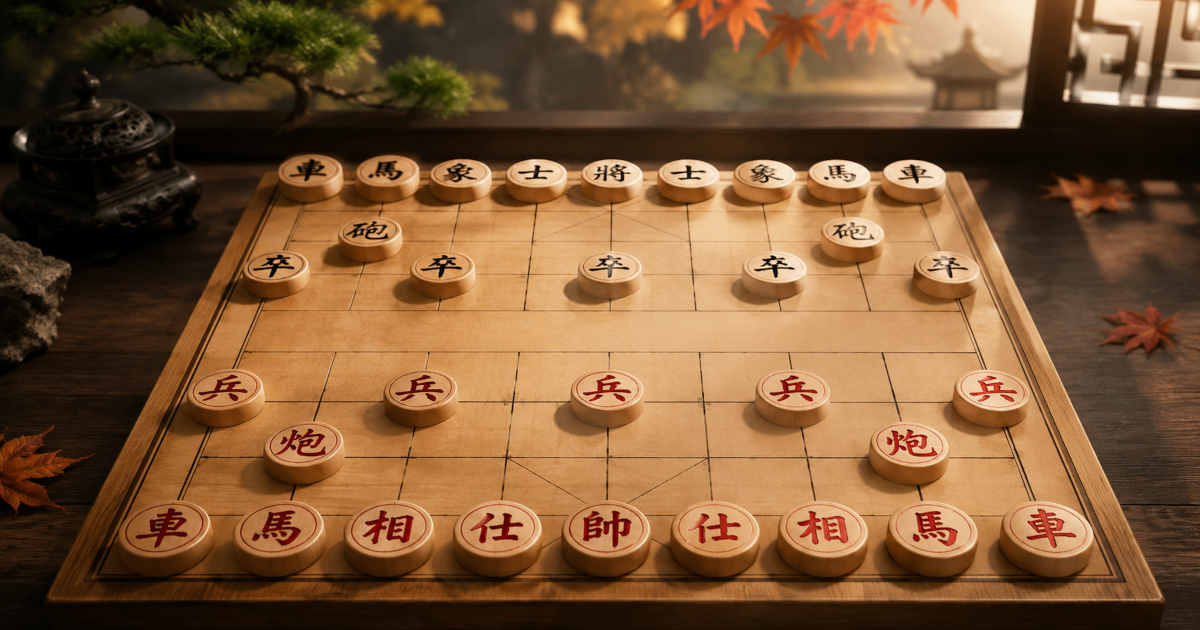
Here is the English translation of the blog post. The structure, formatting, and tables have been preserved to keep it SEO-optimized and ready to publish.
In Xiangqi (Chinese Chess), there is a widely known saying: "The opening determines the advantage, the middlegame determines the victory or defeat, and the endgame determines the master's class." The opening (the first few moves) is like laying the foundation for a house. Only with a solid foundation can the entire game develop smoothly and sharply. If you want to improve your chess skills, understanding and mastering opening formations is an absolute must.
This article will provide you with a comprehensive overview of Xiangqi openings, from basic concepts and golden rules to an analysis of the most classic formations.
What is a Xiangqi Opening and Why is it Important?
The Xiangqi Opening is the first phase of the game, typically lasting for the first 10 to 15 moves. The main objective of this phase is to mobilize forces, occupy strategic positions on the board, and create a tightly coordinated formation among your pieces.
A successful opening phase provides a player with three massive advantages:
- Seizing the initiative: Forcing the opponent to react to your playstyle and tactics, pushing them into a passive, defensive position.
- Optimizing military strength: Deploying main forces (Chariots, Cannons, Horses) to positions with a wide range of activity, making it easy to attack or support the defense.
- Protecting the General: Establishing a solid defensive system in the center and on both flanks (using Advisors, Elephants, and supporting pieces) before entering the fierce middlegame.
Classification of Popular Xiangqi Openings
Over hundreds of years of development, the Xiangqi opening system has been summarized by grandmasters into 4 main groups, based on the piece moved in the very first turn. This classification helps players easily shape their playing style.
1. The Cannon Group (Fierce Attack)
This is the most popular opening group, particularly suitable for those who prefer an aggressive, fiery exchange and want to impose their will early on.
- Central Cannon (Pháo Đầu): Moving the Cannon to file 5 (Cannon 2 to 5 or Cannon 8 to 5). The goal is to aim directly at the central Pawn and threaten the opponent's center.
- Palace-Crossing Cannon (Quá Cung Pháo): Moving the Cannon across the General to the other flank (Cannon 2 to 6 or Cannon 8 to 4) to concentrate firepower on one wing and create a surprise attack.
- Corner Cannon / Advisor Angle Cannon (Sĩ Giác Pháo): Moving the Cannon to the Advisor's corner (Cannon 2 to 4 or Cannon 8 to 6), creating a flexible formation that defends well and easily transitions into a lightning-fast attack.
2. The Horse Group (Defense and Counter-attack)
This group is often used when a player wants to build a rock-solid formation, waiting for the opponent to make a mistake before launching a decisive strike.
- Screen Horse Defense (Bình Phong Mã): Developing both Horses to protect the central Pawn (Horse 2 to 3 and Horse 8 to 7). This is considered the number one nemesis of the Central Cannon.
- Reverse Palace Horse / Single Horse Defense: Other flexible Horse variations that create unique and unpredictable defensive links between the two flanks.
3. The Elephant Group (Deep Defense)
- Flying Elephant Opening (Phi Tượng Cuộc): Moving an Elephant on the first turn (Elephant 3 to 5 or Elephant 7 to 5). This playstyle is characterized by a balance of softness and hardness, "using stillness to control motion." It is highly favored by top players when they want a drawn-out, strategic battle focused on board control and deep positional understanding.
4. The Pawn Group (Probing and Flexibility)
- Fairy Pointing the Way (Tiên Nhân Chỉ Lộ): Pushing the 3rd or 7rd Pawn forward one step (Pawn 3 to 1 or Pawn 7 to 1). This move acts as a "stepping stone" to test the opponent's reaction, allowing the player to flexibly choose a corresponding formation (it can transpose into a Central Cannon, Screen Horse, or Flying Elephant).
Detailed Analysis: Central Cannon vs. Screen Horse
Among thousands of variations, Central Cannon vs. Screen Horse is considered the "eternal song" of Xiangqi. It represents the classic battle between the Spear (the sharpness of Attack) and the Shield (the airtightness of Defense).
Below is a comparison table highlighting the characteristics of these two formations when they face off:
| Characteristic | Central Cannon (Attack) | Screen Horse (Defense) |
|---|---|---|
| Nature | Lightning-fast, aggressive attack | Blended offense/defense, counter-attacking |
| Main Objective | Breakthrough the center, tear apart the defense | Firmly protect the central pawn, develop both flanks evenly |
| Key Advantages | Easy to grasp, direct threats, applies massive psychological pressure early on | Super solid formation structure with no obvious weaknesses |
| Potential Risks | If unable to penetrate the center, it's easy to run out of steam and get hit by a counter-attack | Requires high-level middlegame skills to untangle positions and transition to attack |
The player with the Red pieces (moving first) usually chooses the Central Cannon to showcase overwhelming power, while Black (moving second) uses the Screen Horse to neutralize the pressure and wait for the opponent's flaws.
4 "Golden" Rules for Beginners Learning Openings
If you are a beginner, don't try to memorize moves mechanically. Keep these 4 core principles in mind as your compass in every match:
- Develop Your Chariots Quickly: The Chariot is the most powerful sweeping piece on the board. Never leave your Chariots "imprisoned" in the corners for too long. Bringing them out early helps you control vital vertical and horizontal files.
- Don't move a single piece too many times: In the opening, time (number of moves/tempi) is gold. If you waste 3-4 moves just wandering around with one Cannon or Horse, your other main forces will stagnate, leading to a loose formation that is easily surrounded.
- Comprehensive offense and defense (Develop both flanks evenly): Don't just concentrate your attacking forces on one wing while neglecting the other. A good formation requires synchronized coordination between the Left and Right, ensuring your flanks aren't exposed when you attack.
- Ensure absolute safety for the center: The General and the Advisor/Elephant system in the palace are the heart of the board. Do not carelessly leave your center unguarded, especially when the opponent is preparing to move their Cannon to the middle file.
Frequently Asked Questions (FAQ)
Which opening should a beginner start learning?
You should start with the Central Cannon when playing Red (moving first), and the Screen Horse when playing Black (moving second). These are the two most fundamental formations, helping you train both your attacking intuition and your defensive artistry. Once you master the roots, you can easily pick up other dynamic formations.
How can I remember all the opening variations without getting confused?
The secret is don't learn by rote! Analyze and understand the tactical purpose of each move. Ask questions like: Why develop a Horse here instead of an Elephant? Why move the Cannon to the edge? When you understand the underlying logic, your brain will automatically remember the tactical blueprints systematically. Combining this with studying real matches from grandmasters will help you improve rapidly.
Should I use Xiangqi software to practice openings?
Absolutely. Modern Xiangqi software has massive, continuously updated opening books and incredibly accurate evaluation capabilities. However, you should only use software to analyze your mistakes after actual games. Never abuse it to "play for you," as that will stunt your own calculative thinking.
The Xiangqi opening is a vast and artistic world. Mastering this phase not only significantly increases your win rate but also brings deep intellectual joy when you successfully execute a beautiful strategy. Start with the most basic principles, practice regularly, and constantly review your own games.
