
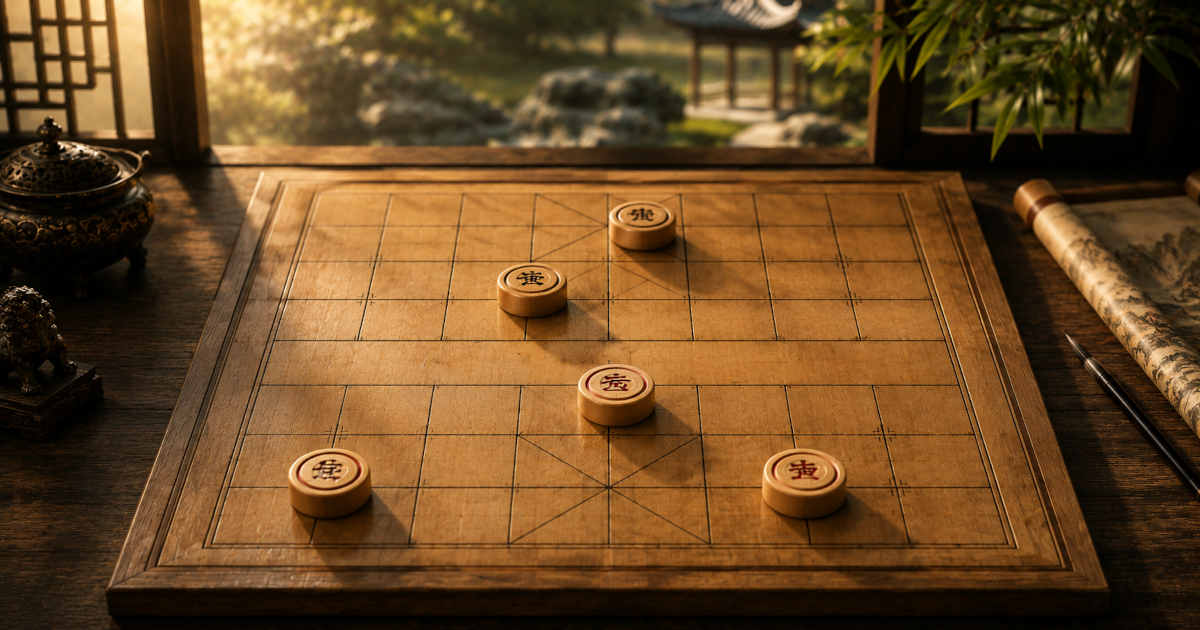
Xiangqi Endgame: A Complete Guide to Winning the Final Stage of Chinese Chess
The Xiangqi endgame is where many Chinese Chess games are truly decided. After the opening battles and complicated middlegame tactics, the board becomes less crowded, but that does not mean the position becomes easier. In fact, the endgame often demands greater precision because every move can dramatically change the result.
In Xiangqi, a single tempo can be worth more than an entire piece. A well-placed Chariot can dominate an open file, a Cannon can create a deadly mating net, and a lowly Pawn can become the deciding factor in a long battle. Understanding these ideas is essential for anyone who wants to improve at Chinese Chess endgame strategy.
This guide explains the fundamental principles of the Xiangqi endgame, including piece activity, Pawn promotion, King safety, common winning techniques, and practical endgame patterns.
What Is the Xiangqi Endgame?
The Xiangqi endgame is the final phase of a game when many major pieces have been exchanged and both players have fewer pieces remaining on the board.
Unlike the middlegame, where attacks, combinations, and tactical threats dominate, the endgame focuses heavily on:
- Piece activity
- King safety
- Passed Pawns
- Tempo and move order
- Positioning
- Material conversion
- Accurate calculation
A player may be ahead by a Chariot and still fail to win if the pieces are badly placed. Likewise, a player who appears to be losing can sometimes save the game through perpetual checks, perpetual threats, fortress positions, or careful defensive technique.
This is why mastering Xiangqi endgame principles can dramatically improve your overall playing strength.
Why the Endgame Is So Important in Xiangqi
Many beginners spend most of their training on openings and tactical combinations. Those skills are important, but the endgame deserves just as much attention.
A strong endgame player can convert small advantages into victories. For example, winning a Pawn in the middlegame may seem insignificant. However, after several exchanges, that extra Pawn could become a decisive advantage.
The endgame also rewards players who understand long-term planning. Instead of asking only, "What can I capture?" you need to ask:
Where should my pieces be placed three, five, or ten moves from now?
That change in thinking is one of the biggest differences between beginner and advanced Xiangqi.
1. Activate Your Pieces
The first major principle of the Xiangqi endgame is simple:
Active pieces are usually more valuable than passive pieces.
A Chariot trapped behind several Pawns may have excellent material value, but it is not doing much. A Chariot controlling an open file, attacking an exposed King, or supporting a passed Pawn can be enormously powerful.
The same applies to Horses and Cannons.
When entering an endgame, look for ways to improve your pieces immediately. Ask yourself:
- Can my Chariot enter the opponent's territory?
- Can my Horse attack weak Pawns?
- Can my Cannon create a checking opportunity?
- Can my Advisor or Elephant improve defensive coordination?
- Can my King move toward the center safely?
In many positions, improving a badly placed piece is stronger than winning a Pawn immediately.
2. King Safety Still Matters
Xiangqi Kings, often called the Generals, are restricted to the Palace. This makes King safety fundamentally different from Western Chess.
Even during the endgame, you cannot simply assume that the reduced number of pieces makes your General safe.
Open files and ranks can create direct attacking opportunities. Chariots are especially dangerous when they gain access to the General's area.
One important Xiangqi rule is the Flying General rule: the two Generals cannot face each other directly on the same file without an intervening piece.
This rule has major endgame consequences.
Sometimes a player can exploit an open file to force the opponent's General into a vulnerable position. At other times, maintaining a blocking piece becomes essential for survival.
Therefore, before exchanging the last defending piece, always consider whether you are accidentally opening a line toward your General.
3. Passed Pawns Become Extremely Dangerous
Pawns are often underestimated by beginners in Xiangqi.
A Pawn that has crossed the river can become a serious attacking force because it gains the ability to move horizontally as well as forward.
This makes advanced Pawns particularly important in the endgame.
A well-supported Pawn can:
- Restrict the enemy General
- Attack Advisors
- Force defensive pieces into awkward positions
- Create mating threats
- Support a Chariot or Cannon
- Distract the opponent while another piece attacks elsewhere
A common mistake is to push every Pawn forward as quickly as possible.
That is not always correct.
Sometimes a Pawn is stronger when it stays where it is because its position restricts an enemy piece or maintains control over a critical square.
The best endgame players know when to advance a Pawn and when to keep it fixed.
4. Learn the Power of the Chariot
The Chariot (Rook) is arguably the most important piece in many Xiangqi endgames.
Once the board becomes more open, the Chariot gains enormous mobility. It can attack along ranks and files, check the General, capture Pawns, defend friendly pieces, and support an advanced Pawn.
A common endgame concept is to place the Chariot behind a passed Pawn.
This allows the Chariot to support the Pawn while maintaining flexibility. If the opponent attacks the Pawn, the Chariot can defend it. If the opponent's General becomes exposed, the Chariot can switch to an attacking role.
Another powerful technique is side checking, where the Chariot repeatedly checks the enemy General from the side. This can restrict the opponent's movement and potentially create a perpetual-check situation.
However, do not assume that every Chariot endgame is automatically winning.
Material advantage does not guarantee victory. Defensive fortresses and perpetual checks can make some positions extremely difficult to convert.
5. Understand Cannon Endgames
The Cannon behaves differently from the Chariot and becomes especially interesting in reduced-material positions.
Cannons require a screen to capture, which means their strength depends heavily on board structure.
In the endgame, the number of possible screens often decreases, making Cannon activity more difficult to judge.
A Cannon can be powerful when it:
- Controls the Palace
- Attacks Advisors
- Uses a Pawn as a screen
- Coordinates with the Chariot
- Creates checking threats
However, a Cannon without useful screens can become surprisingly passive.
When evaluating a Cannon endgame, do not look only at the number of pieces. Look at whether the Cannon actually has tactical access to meaningful targets.
6. Horse Endgames Require Precision
Horse endgames can be difficult because Horses have limited mobility compared with Chariots.
The Horse is vulnerable to being blocked by pieces and Pawns. Its movement can also be restricted by "leg" obstructions.
For this reason, an active Horse is extremely valuable.
Try to place the Horse where it can attack multiple targets while avoiding positions where the opponent can easily restrict it.
Horse endgames often involve maneuvering rather than immediate tactics. A player may spend several moves improving the Horse before launching the decisive attack.
Patience matters.
7. The Importance of Zugzwang and Tempo
One of the most fascinating aspects of Xiangqi endgames is the importance of tempo.
A player may have an excellent position but make a losing move simply because the move order is wrong.
Sometimes you want your opponent to move first. Sometimes you need to create a waiting move.
This is closely related to the concept of zugzwang, where a player is forced to make a move that weakens their own position.
For example, an opponent may have only one safe square for a defensive piece. If you can force that piece to move, you may create an immediate tactical opportunity.
Because Xiangqi boards can become very open during the endgame, tempo can be decisive.
Never rush.
Before making a move, ask:
"What happens if I simply improve my position and let my opponent move?"
That question can reveal powerful endgame ideas.
8. Exchange Pieces When It Helps You Win
Trading pieces is generally useful when you have a clear advantage, but exchanging pieces blindly can be a serious mistake.
Suppose you are ahead in material. Simplifying the position may make your advantage easier to convert.
However, not every exchange is beneficial.
Before trading, consider:
- Will the resulting position still be winning?
- Does the exchange activate the opponent's remaining piece?
- Does removing a piece expose your General?
- Will the opponent's Pawn structure become stronger?
- Does the trade create a fortress?
Good Xiangqi players do not exchange pieces simply because they can. They exchange pieces because the resulting position is favorable.
9. Defensive Technique Is Just as Important
Winning the Xiangqi endgame is only half the skill.
You also need to know how to defend difficult positions.
When behind, look for:
Perpetual checks: Repeatedly checking the opposing General may prevent the opponent from coordinating their forces.
Fortresses: Some positions can be defended by creating a structure that the stronger side cannot penetrate.
Blockades: A defensive piece may stop an advanced Pawn or prevent a Chariot from entering.
Counterattacks: Instead of passively defending, create threats against the opponent's General.
This final point is especially important.
Passive defense often allows the stronger side to improve slowly. Active defense forces the attacker to calculate and can create drawing opportunities.
Common Xiangqi Endgame Mistakes
Many players repeat the same errors when entering the endgame.
Moving Too Fast
The endgame often looks simple because fewer pieces remain. That is misleading. With fewer pieces, every move can have greater consequences.
Ignoring the General
Players sometimes become obsessed with winning Pawns and forget that the enemy General can suddenly become vulnerable.
Keeping Pieces Passive
Having a material advantage is not enough. Your pieces must actually participate in the position.
Pushing Pawns Without a Plan
A Pawn move is permanent. Do not push simply because you have the opportunity.
Failing to Calculate Exchanges
An apparently favorable trade can transform a winning position into a drawn one.
How to Improve Your Xiangqi Endgame
The best way to improve is to study specific endgame positions, not just memorize general principles.
Focus on common material combinations such as:
- Chariot vs. Chariot
- Chariot vs. Horse
- Chariot and Pawn vs. Chariot
- Cannon vs. Horse
- Horse and Pawn vs. Advisor and Elephant
- Chariot and Cannon vs. Chariot
- Multiple advanced Pawns versus defensive pieces
For each position, try to understand the winning plan rather than memorizing a sequence of moves.
Ask yourself:
What is the most important weakness?
Which piece should be improved first?
Where should the General go?
Which exchange favors me?
Can I create a passed Pawn?
Can I force the opponent into zugzwang?
These questions develop practical endgame thinking.
Practice With Endgame Puzzles
Endgame puzzles are an excellent training method because they force you to calculate concrete variations.
Instead of playing full games every time you practice, spend some sessions solving positions from a specific material configuration.
For example, give yourself a position with one Chariot and several Pawns per side and try to determine whether the position is winning, drawing, or losing.
This type of training teaches you to recognize patterns much faster.
You can also analyze your own games and identify the moment when the middlegame transitioned into the endgame. Ask whether you chose the correct exchange and whether your pieces were optimally placed.
Final Thoughts
The Xiangqi endgame is a fascinating combination of calculation, strategy, patience, and precision. While the opening determines how the game develops and the middlegame often produces spectacular tactics, the endgame determines whether you can actually convert your advantage.
The most important principles are straightforward:
Activate your pieces. Protect your General. Use advanced Pawns carefully. Understand Chariot activity. Respect tempo. Calculate exchanges. And never assume a material advantage automatically means a win.
The greatest improvement often comes from learning to see the board differently. In the endgame, every square matters, every tempo matters, and every piece has a job.
Master these ideas, study practical endgame positions, and your Chinese Chess endgame technique will become much stronger.
And remember: in Xiangqi, the game is not won when you are ahead.
It is won when you know how to finish the job.
